Overview
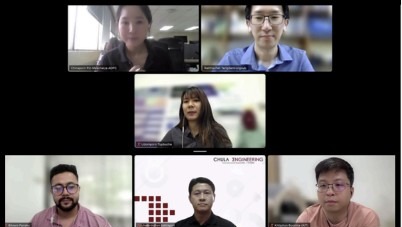
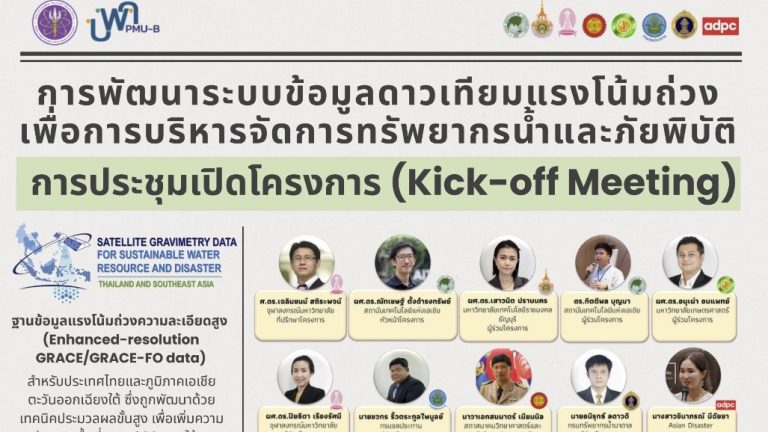
The Asian Institute of Technology (AIT) recently held the kick-off meeting for a new research project on 13 March 2026. The project is titled “Enhancing the Use of Satellite Gravimetry for Sustainable Water Resource and Disaster Management in Thailand and Southeast Asia Under Climate Change Challenges” funded by the Program Management Unit for Frontier Brainpower and Future Industries, Thailand. The project aims at advancing satellite gravity data applications for water resources and disaster management in Thailand and Southeast Asia.
The project is led by Dr. Natthachet Tangdamrongsub, Assistant Professor at the Water Engineering and Management (WEM) program at AIT, with Dr. Kittiphon Boonma, Research Specialist at the Geoinformatics Center (GIC), serving as part of the research team. Other research members are Chulalongkorn University, Asian Disaster Preparedness Center (ADPC), Rajamangala University of Technology (RMUT), Royal Irrigation Department (RID), Council of Scientific and Technological Associations of Thailand (COSTAT), Kasetsart University (KU) and Department of Groundwater Resources.
Project Description
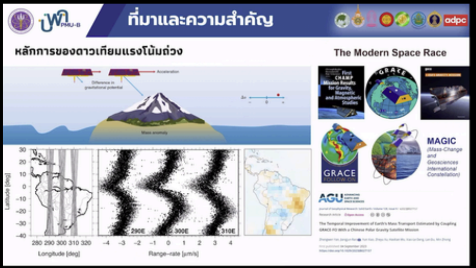
The project focuses on developing enhanced-resolution gravity datasets derived from the GRACE (Gravity Recovery and Climate Experiment) and GRACE-FO (GRACE Follow-On) satellite missions to support monitoring hydrological changes across the region. By applying advanced data processing techniques, the team aims to improve the spatial resolution of satellite gravity observations from roughly 300 km to about 10 km, enabling more practical applications at the local and watershed scales.
These improved datasets will support monitoring of groundwater dynamics, flood and drought conditions, and land subsidence, contributing to more informed decision-making for water resources management and climate-related disaster preparedness in Thailand and Southeast Asia.
The initiative also aims to strengthen regional scientific capacity through open-access data development, international research publications, and training programs for over 150 stakeholders, while fostering collaboration among research institutions working on satellite-based Earth observation technologies.